
On the horizon of East Africa stand two mountains everyone recognizes by silhouette, though few people can really tell them apart. Kilimanjaro, in Tanzania, is Africa’s highest mountain and one of the most photographed on the planet. Mount Kenya, its neighbor across the border in Kenya, is the continent’s second-highest peak and the one almost nobody knows: an extinct volcano with high-altitude lakes, bamboo forest, and rock summits you don’t even need to climb if you pick the right route.
Neither requires previous technical experience, and both end up being, for anyone who has done them, a decision people think about longer than expected.
But choosing the mountain is only half the decision: the other half is the route. Neither one is climbed by a single path, and the one you choose changes the experience almost as much as the mountain itself: how much you see, how many people you encounter, how much time you need to acclimatize properly. Here’s what changes from route to route.

Kilimanjaro rises alone, with no surrounding range, in northern Tanzania: a dormant volcano that cuts the horizon at 5,895 meters at its highest point, Uhuru Peak, the tallest free-standing mountain in the world. You don’t need ropes or a harness to reach the top, just legs, time, and proper acclimatization. There are seven official routes to the summit, and each one has its own character.
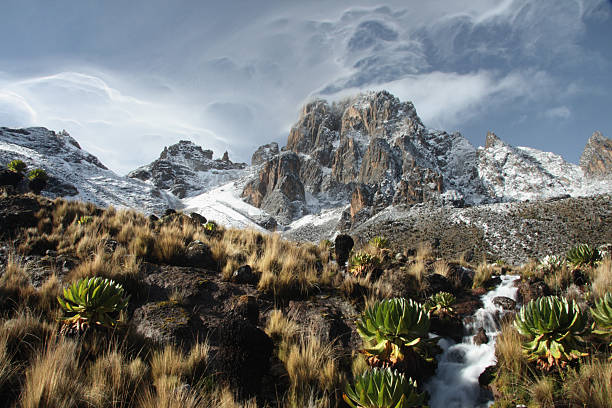
Mount Kenya rises across the border, in Kenya, almost on the equator. It’s an older, more eroded volcano, with three summits: Batian and Nelion, which do require real technical climbing, and Point Lenana, at 4,985 meters, reachable on foot if you pick the right route. It has fewer official routes than Kilimanjaro, but no less character.
At Thin Air, we climb Kilimanjaro via the Lemosho route, the one that offers the best acclimatization and the best summit odds of the seven that exist. It starts on the most remote side of the mountain, so for the first days you walk nearly alone, and the climb takes 9 days: plenty of time for your body to adjust to the altitude.
What truly impresses about Kilimanjaro is how much changes around you without you ever changing mountains: you climb through tropical rainforest, then heath and moorland, then an almost lunar high-altitude desert, until you reach an ice-and-rock cap at the summit. Five distinct ecosystems, one after another, on a single climb.
None of this would be possible without the team that makes it work: guides with dozens of summits behind them, cooks, and a crew of porters who overtake you every day carrying the tents, food, and water, and who have everything set up and ready by the time you reach camp. It is, quite literally, a small village moving up the mountain with you.
On Mount Kenya, we run the Sirimon-Chogoria traverse, the combination that packs in the most contrast anywhere on the mountain. We climb via Sirimon, on the drier side, gaining altitude gradually through forest and moorland, and spend the night at Shipton’s Camp, right beneath the glaciers, before summit day at Point Lenana (4,985m).
The descent is via Chogoria, and that’s where the mountain saves the best for last: the Mackinder Valley, high-altitude lakes, and waterfalls you won’t see from any other side. A certified guide and a small crew of porters accompany you the whole way, with the tents already up by the time you arrive at camp.
Kilimanjaro is, above all, a large-scale operation: many days, a sizeable team, and a climb that doesn’t let up until the very end. Mount Kenya is more compact, with less infrastructure and a more intimate feel, while being just as wild. Neither is easier than the other: each one is experienced in its own way.
If you want to be able to say you’ve climbed the highest mountain in Africa, Kilimanjaro wins without question, and the Lemosho route gives you the best odds of getting there. If what you’re after is a lesser-known mountain with the same intensity in fewer days, Mount Kenya is the surprise. And if you have time to spare, you don’t have to choose: some people combine both on a single East African trip.
See el Monte Kenia · See Kilimanjaro