

What to pack for your trip
What you need for a trek or a high-altitude expedition, what each item is for and where it’s not worth cutting corners.
Gear is not a minor detail
At altitude, small problems get bigger. A sock that’s too tight, a layer that isn’t warm enough when the temperature drops, or boots you haven’t broken in are a nuisance at sea level, but at 5,000 metres they can force you to turn back. Up there, there’s no shop around the corner.
The good news is you don’t need to spend a fortune. Once you understand what each piece is for, you can make the most of what you already own and only buy what’s missing. Below is what comes up on almost every high-altitude trip. We’ll give you the exact list for your trip, because Everest doesn’t call for the same kit as Aconcagua.
The layering system
In the mountains the temperature changes a lot during the day: you sweat on the way up at midday and get cold as soon as you stop or the sun goes down. Instead of one very thick garment, you combine several thin layers that go on and come off. Each one has a different job, and the system only works if each layer does its own.
| Layer | Its job | What to look for |
|---|---|---|
| Base | Sits next to the skin and moves sweat away so you don’t get cold | Thermal top and leggings in synthetic fibre or merino wool. Never cotton: when it’s wet, it chills you. |
| Mid | Holds in body heat | Fleece, or a light down or synthetic jacket. |
| Outer | Blocks wind and rain while letting moisture out | Waterproof, breathable jacket and trousers. |
| Insulation | Extra warmth for nights and summit day | A thick down jacket that you only wear when you’ve stopped or it’s very cold. |
- When you set off: start slightly cold. Ten minutes of walking uphill will warm you up
- While you walk: the aim is to sweat as little as possible. Take layers off before your base layer gets soaked, because that moisture chills you the moment you stop
- When you stop: put a layer on straight away, not once you’re already cold
- Keep your waterproof handy: the weather can change in minutes, so it goes at the top of your pack, not the bottom
Head, hands and feet
You lose a lot of heat through your extremities. Covering them properly makes more difference than a more expensive jacket.
- A warm hat, plus a cap or sun hat
- Gloves: a thin pair and a warm pair, plus a spare: if they get wet, they won’t dry on the trail
- Technical socks of medium thickness. Socks that are too thick squeeze your feet, cut off circulation and actually make you colder
- Several spare pairs: feet sweat even in the cold
- Neck gaiter or buff, for wind and dust
Boots and camp shoes
This is the last place to save money, and the right boot depends on the trip: not just the altitude, but also how cold it gets on summit day. That’s why there’s no fixed rule, and we’ll tell you which one you need in your trip’s gear list.
| Type | What it’s like | What it’s for |
|---|---|---|
| Trekking boot | Mid or high ankle, waterproof | Walking several days on mountain trails |
| Mountaineering boot | Stiffer and crampon-compatible | Peaks with snow or ice |
| Double boot | With an insulated inner boot, for extreme cold | Very cold or very high summits. On some trips under 6,000 m it’s also used for summit day |
- Break your boots in: wear them for several weeks before you leave. Brand-new boots straight out of the box are the number one cause of problems on the trail
- Camp shoes: light trainers or down booties for camp or the lodge, so your feet can rest and stay warm
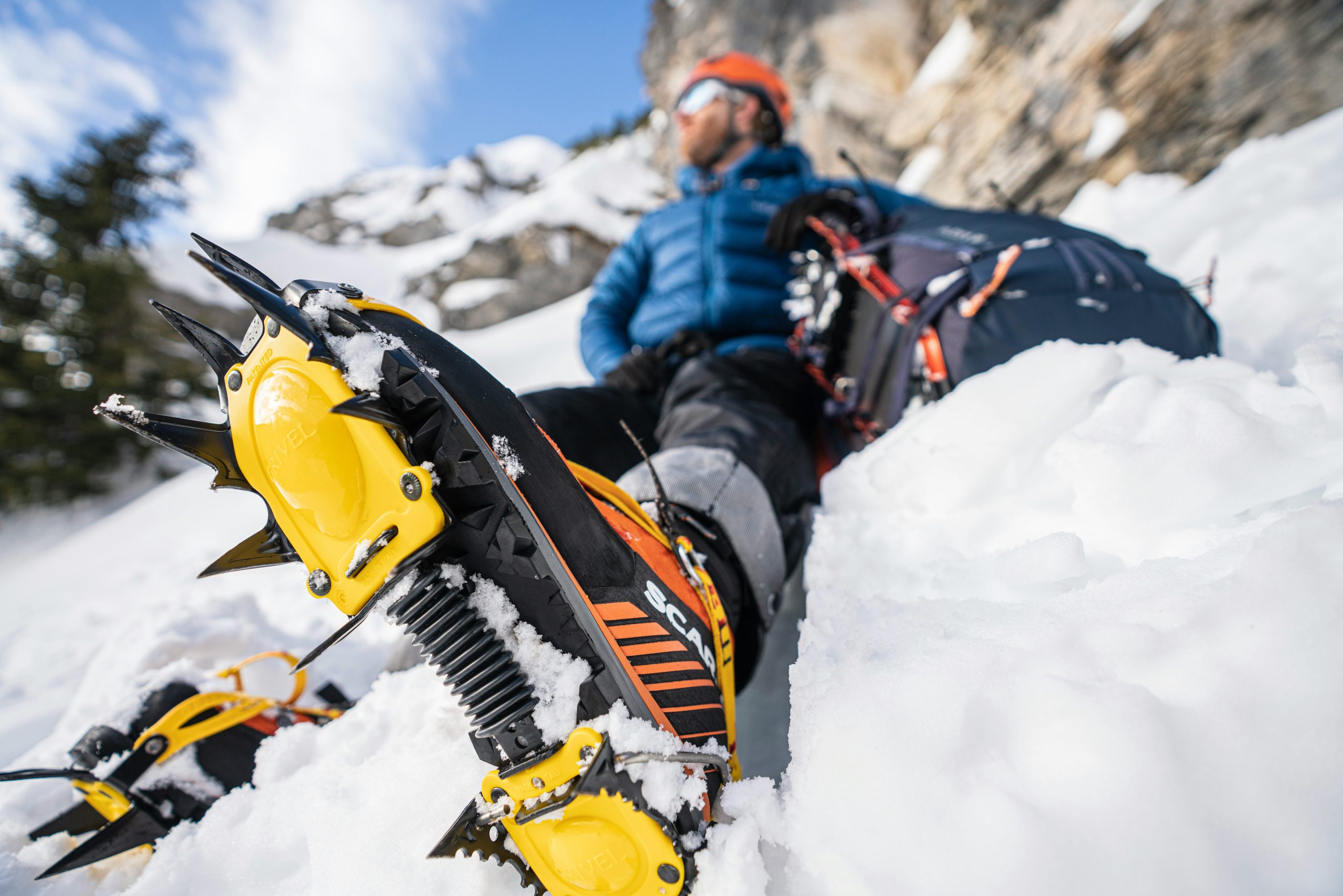
Crampons, ice axe, ropes and co.
You won’t need it on the treks. You will on peaks with snow or ice and on high-altitude expeditions. There are two kinds: group gear, which we provide, and personal gear.
| Gear | What it’s for | Who provides it |
|---|---|---|
| Ropes, carabiners and cords | Securing the group on exposed sections and setting up fixed lines | We do |
| Crampons | Attach to your boots to grip hard snow and ice | You, or rent them locally |
| Ice axe | Support on snow slopes and to stop a fall (self-arrest) | You, or rent one locally |
| Harness | Roping up or clipping into fixed lines | You, or rent one locally |
| Helmet | Protection from falling rock or ice | You, or rent one locally |
Personal gear can be rented locally on all our trips. Your trip’s gear list tells you exactly what you need.
What you carry and what you don’t
- Daypack of 30–40 litres, with what you need during the day
- Duffel bag for everything else, carried by porters or mules. The weight limit depends on the trip
- Sleeping bag rated for the coldest night of the itinerary, not the destination’s average
- Trekking poles, which take a lot of strain off your knees on the way down
- Headlamp with spare batteries
- Bottles or a hydration bladder for around 2–3 litres of water a day
The small things you can’t forget
At altitude the sun burns harder and there’s no pharmacy nearby.
- Sunglasses, category 3, or category 4 if you’ll be on snow or glacier
- High-factor sunscreen and lip balm
- Purification tablets or a filter for drinking water
- Personal first-aid kit: blister plasters, your usual medication and whatever your doctor recommends for the trip
What you can leave at home (or at the hotel)
- Everyday clothes: leave them in a bag at the hotel for when you get back
- Extra socks beyond your spare pairs
- Technical gear, if your trip doesn’t need it
- Anything “just in case” that isn’t on your list: you feel every gram, every hour
Want the exact list for your trip?
Every destination calls for something different: sleeping in lodges on the way to Everest is not the same as camping on Kilimanjaro. Leave us your email and we’ll send you the list for yours.
And if you want to arrive fit, get a training plan →