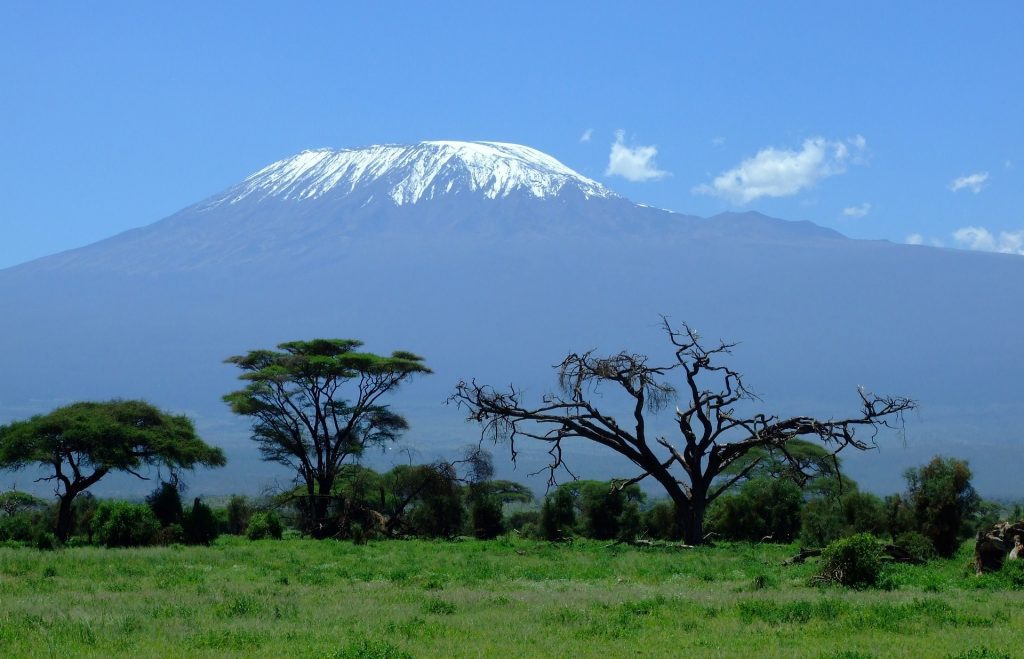
Few mountains make an entrance like Kilimanjaro. It rises suddenly from the Tanzanian savannah, alone, with no range around it, its white summit sometimes floating above the clouds. It is the roof of Africa, 5,895 metres at Uhuru Peak, and the highest free-standing mountain on the planet: an old volcano made of three cones, Kibo, Mawenzi and Shira, that rises almost five thousand metres above the plains around it.
Climbing it is, above all, a journey through ecosystems. In a few days you go from the coffee and banana farms on its lower slopes to a rainforest that looks straight out of a fairy tale, with colobus monkeys in the trees; then come heath and moorland, with giant lobelias and groundsels that grow nowhere else; then an alpine desert of volcanic rock and, finally, the ice of the glaciers that still cling to the summit.
The first recorded ascent was in 1889, when the German geographer Hans Meyer and the Austrian climber Ludwig Purtscheller reached the top with the help of a local guide, Yohani Kinyala Lauwo. Today you need no technical experience to climb it, but you do need to choose your route well, give your body time to acclimatise and know what awaits you on summit night.
There are seven routes up Kilimanjaro, and the choice changes the trip a great deal. We have done both Marangu and Lemosho, and for our groups we choose Lemosho.
Lemosho, the one we recommend. It starts in the west, in the forest at Londorossi Gate, and crosses the Shira Plateau, the oldest of the three cones. It is the most scenic route: you see the mountain on many more days, and its profile gives the best acclimatisation of the usual routes, with days when you climb high and come back down to sleep lower. It passes the Lava Tower, an old volcanic plug at about 4,600 metres and one of the most striking places on the whole climb, and the next day climbs the Barranco Wall, a face of about 250 metres tackled on a steep path with no technical difficulty, using your hands here and there. You sleep in tents, and with seven or eight days on the mountain it gives you the best chance of reaching the top in good shape.
Machame. It climbs from the south, also through the forest, and joins Lemosho on the Shira Plateau. From there the two share the trail to the summit. It is a little shorter and the busiest of all.
Marangu. The only route with huts, Mandara, Horombo and Kibo, with bunks in shared cabins, which does not necessarily mean more comfort. Its great strength is the volcanic landscape: the crossing of the saddle between Mawenzi and Kibo is a desert of lava and ash that looks like another planet. You go up and down the same way, and being shorter, acclimatisation is tighter.
Rongai. The only route from the north, on the side facing Kenya. It is quiet, gently graded and drier, a good choice in the rainy months.
Northern Circuit. The longest, eight to nine days: it starts like Lemosho and circles the mountain’s northern side. Very few people and excellent acclimatisation.
Shira. It starts by vehicle at around 3,500 metres, so it skips the forest and requires you to arrive already somewhat acclimatised.
Umbwe. The shortest and steepest, only advisable if you already have experience at altitude.
The last day starts around midnight. You climb slowly, by headtorch, in the dark and the cold, while the guides and porters sing to set the pace; it is one of those things you never forget. On Lemosho and Machame you reach the crater rim at Stella Point and go on to Uhuru Peak, passing two of the summit points. On Marangu you come out on the crater at Gilman’s Point and follow the rim past Stella Point to Uhuru, three in all.
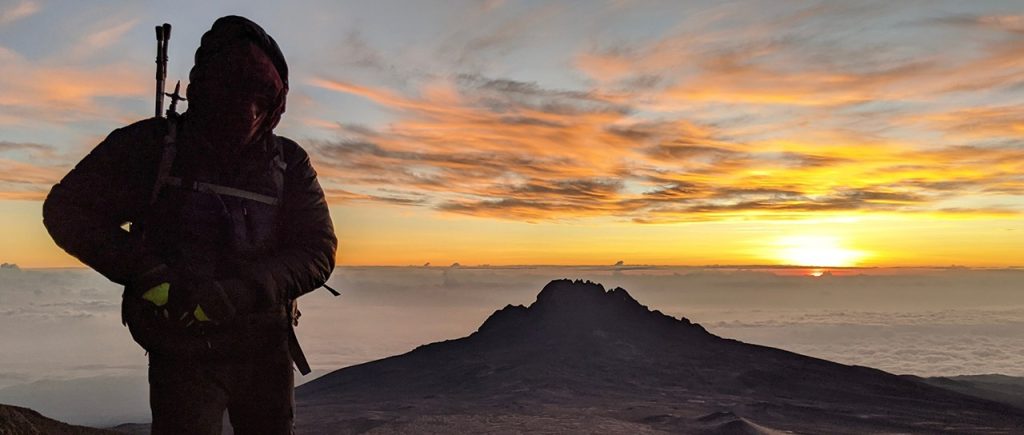
And then the sun comes up. It rises behind Mawenzi, the jagged peak beside Kibo, and turns the sea of clouds below orange. The final metres are among the snow and glaciers of the summit, a dramatic change after days of forest, heath and rock. That sunrise, and the sunset the evening before from the last camp, are what every route has in common.
The rule is simple: the more days, the better the acclimatisation and the better your chance of reaching the top. Marangu is usually done in five or six days; Machame in six or seven; Lemosho in seven or eight on the mountain. Our programme is 9 days in total, with 7 on the mountain via Lemosho, arriving and leaving through Arusha and Moshi.
National park fees are charged for every day inside the park and make up most of the cost of the climb. That is why longer routes cost more, and why very cheap offers deserve suspicion: they usually cut days or staff.
Kilimanjaro has two dry seasons: January to early March, warmer and quieter, and June to October, the most stable and also the busiest. April, May and November are the rainy months. We cover it in detail in the best time to climb Kilimanjaro.
Our departures are 26 December to 3 January and 6 to 14 March 2027, via the Lemosho route.
You do not need to climb or carry technical gear, but it is a very serious mountain because of the altitude. Most days are 4 to 7 hours at a steady pace, and summit night can stretch to 12 or 14 hours up and down. What weighs most is not the effort but the height: above 4,000 metres almost everyone feels some symptoms, and what makes the difference is going slowly, drinking plenty and choosing a route with good acclimatisation. We explain it in altitude sickness and acclimatisation.
If you are weighing up this mountain against others, you may also find Elbrus vs Kilimanjaro or Mount Kenya vs Kilimanjaro useful.
What is the best route up Kilimanjaro?
For most people, Lemosho: it is the most scenic and allows the best acclimatisation. Marangu is the only route with huts and stands out for its volcanic landscape, but it is shorter and acclimatisation is tighter.
How many days do you need to climb Kilimanjaro?
Between five and eight days on the mountain, depending on the route. On Lemosho, seven or eight is recommended. Our programme is 9 days in total, with 7 on the mountain.
Do you need experience to climb Kilimanjaro?
You need no technical or climbing experience, but you do need good fitness and to prepare for the altitude, which is the hardest part of the mountain.
When is the best time to climb Kilimanjaro?
In the dry seasons: January to early March and June to October. April, May and November are the wettest months.
How high is Kilimanjaro?
Uhuru Peak, the highest point, is 5,895 metres. It is the highest mountain in Africa and the highest free-standing mountain in the world.