
At a glance
- Duration: 12 days from Kathmandu
- Highest point: 4,130 m (Annapurna Base Camp)
- Difficulty: moderate, no technical sections
- Accommodation: mountain teahouses
- Best time: spring (March to May) and autumn (October and November)
- Starting point: Pokhara
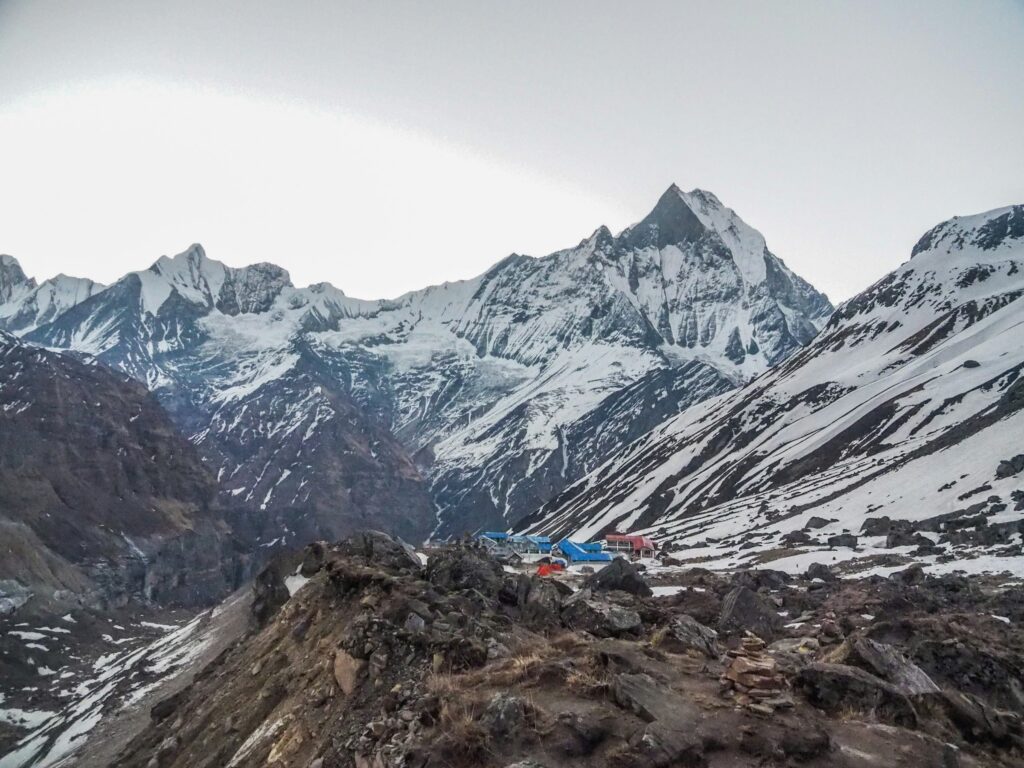
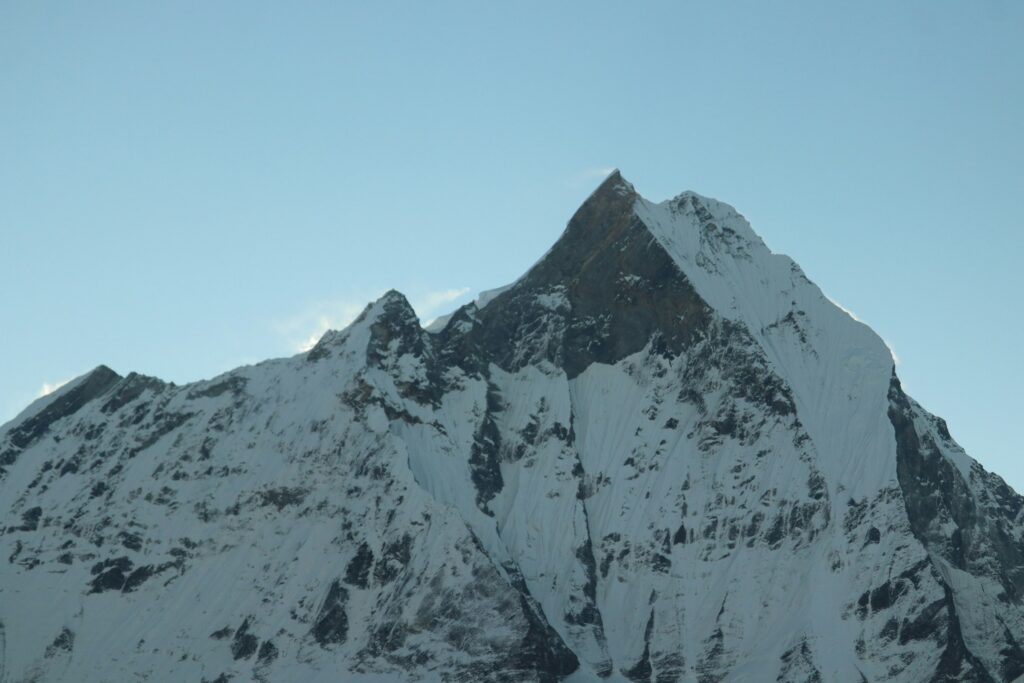
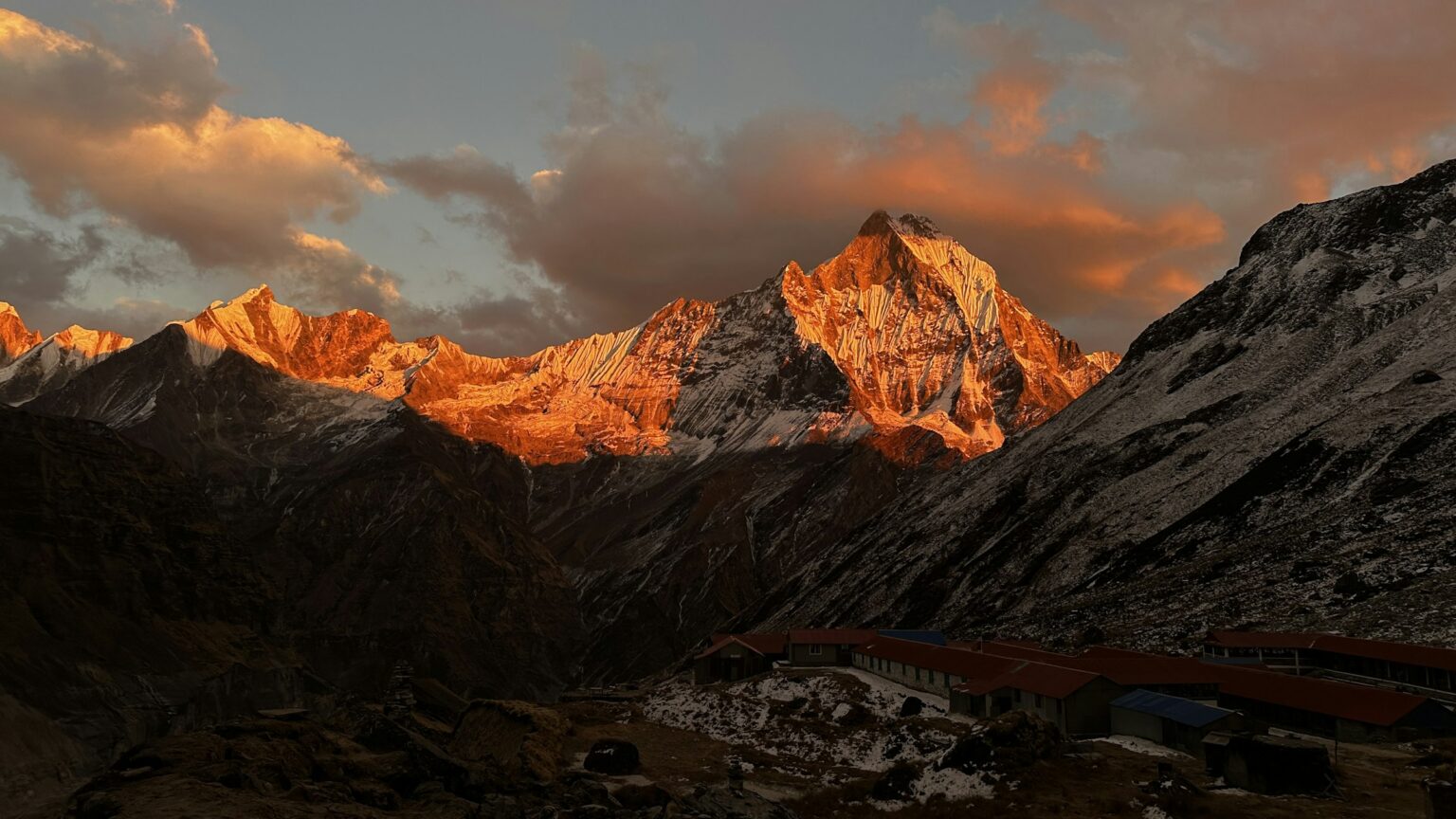
There is a place in Nepal where the mountains close in around you on every side. You reach it on foot, climbing out of the rice terraces, through bamboo and rhododendron forest, past Gurung villages clinging to the hillside and up thousands of stone steps. At the head of the valley the trail opens out into the Sanctuary: an amphitheatre of ice with Annapurna I (8,091 m), the tenth-highest mountain on Earth, in front of you, and Machhapuchhre, the sacred fishtail peak, at your back. This is Annapurna Base Camp, at 4,130 metres, and it is one of the most beautiful treks in the Himalaya.
You don’t need mountaineering experience, and you don’t need to go above 5,000 metres. What you need is good fitness, legs for the steps and the desire to spend a night in the middle of that amphitheatre. In this guide we cover when to go, the route day by day, how hard it is and how to prepare.
| Months | Annapurna Base Camp |
|---|---|
| March, April and May | Very good: rhododendrons in bloom and long days |
| October and November | Very good: clearer skies and sharper views |
| December to February | Possible, with cold and snow higher up |
| June to September | Monsoon: rain, mud and leeches in the lower forests |
Spring and autumn are Nepal’s two trekking seasons. In spring the rhododendron forests, Nepal’s national flower, turn red and pink, and afternoons often cloud over. In autumn, after the monsoon, the air is cleaner and mornings usually dawn clear.
We have departures in March 2027, on 10–21 March and 21 March – 1 April. By then the days are mild in the lower villages, and nights at Base Camp drop to around −5 °C to −10 °C.
The trek starts in Pokhara, Nepal’s second city, at 823 metres and about 200 km west of Kathmandu. There are two ways to get there from Kathmandu: a flight of around 25 minutes or the road. We go by private jeep, 7 to 8 hours of curves alongside the Trisuli River, arriving with the afternoon free to stroll by Phewa Lake.
Pokhara is one of the few places in the world where you can see peaks over 6,000 metres from just 800. If you have spare days at the end, it is worth staying on: we tell you why in Pokhara, the gateway to the Annapurnas.
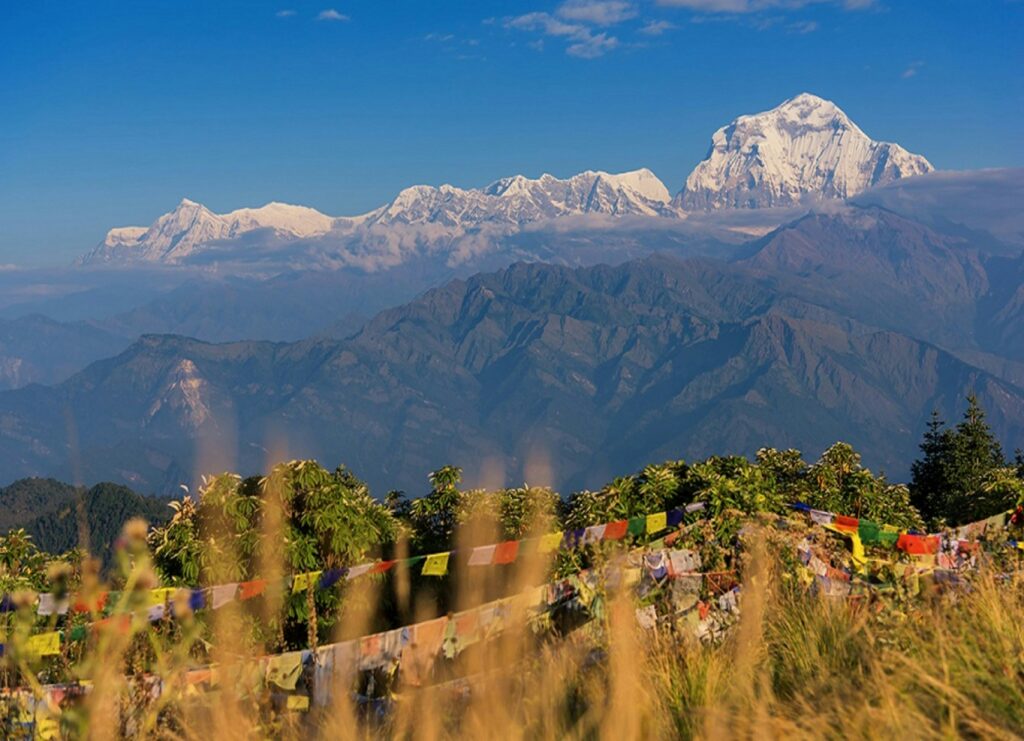
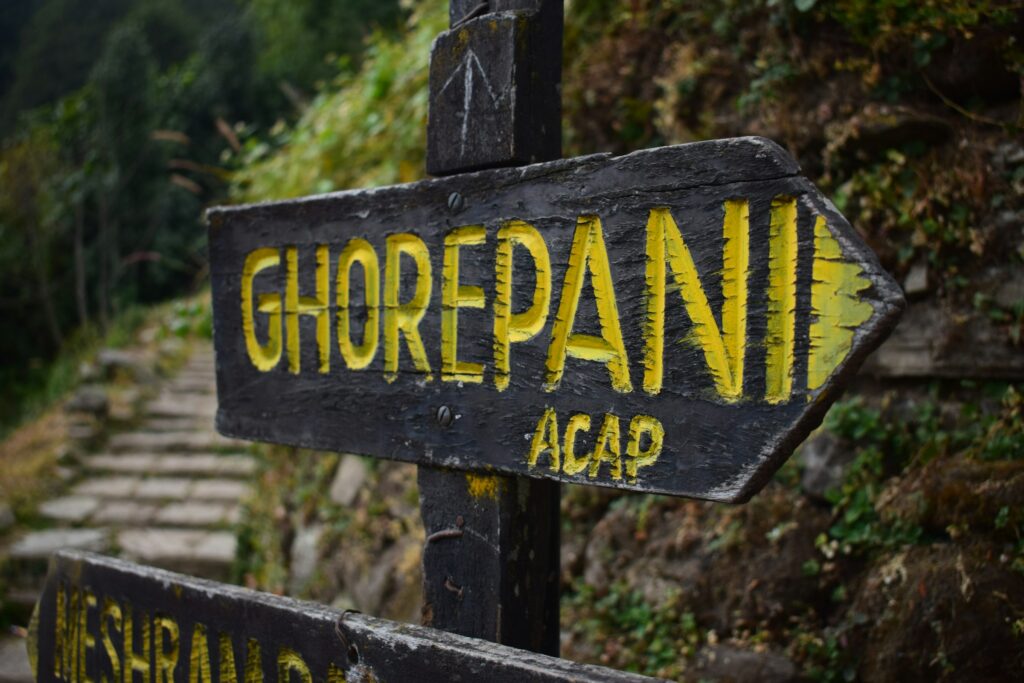
There are several ways into the Sanctuary. Ours first climbs to Ghorepani and Poon Hill, for sunrise over Annapurna and Dhaulagiri, and then enters the Modi Khola valley up to Base Camp. That’s seven days on the trail, there and back, through the Annapurna Conservation Area.
Pokhara – Ghorepani (2,874 m)
A short drive to Hile and the walking begins: the famous stone staircase of Ulleri, some 3,000 steps cut into the hillside, then rhododendron and oak forest up to Ghorepani. It is the day that weighs most on the legs, so take it slowly.
Poon Hill (3,210 m) – Tadapani (2,680 m)
You set off in the dark, with a head torch, to reach the Poon Hill viewpoint before dawn. As the sun rises, Dhaulagiri, Annapurna South and Machhapuchhre light up one after another. Then an easy day along the ridge to Tadapani.
Tadapani – Sinuwa (2,300 m)
Steps down to the river, a suspension bridge and a climb through bamboo to Sinuwa, a handful of teahouses above a gorge. From here the valley narrows and the Sanctuary begins.
Sinuwa – Deurali (3,230 m)
The forest falls away. Past Hinku Cave the valley opens up, rock walls streaked with waterfalls appear, and you cross several log bridges to Deurali.
Deurali – Annapurna Base Camp (4,130 m)
The big day. You climb via Bagar to Machhapuchhre Base Camp (3,700 m), with the mountain right above you, and from there, now above the trees, into the amphitheatre of Annapurna Base Camp. That night you sleep inside the Sanctuary, surrounded by peaks over 7,000 metres.
The descent: Chhomrong and Pokhara
The next day you drop almost 2,000 metres to Chhomrong, a Gurung village stepped down the hillside. On the last day you walk down to Naya Pul and drive to Pokhara, where the trek ends. Then it’s back to Kathmandu and a free day before flying home.
The full itinerary, with distances and elevation gain, is on the Annapurna Base Camp trek page.
Yes. Annapurna Base Camp has no technical sections: it is a trail, steep at times, that you simply walk. What it does ask for is good fitness. Days are 4 to 6 hours and the path is full of stone steps, uphill and downhill, which are more tiring than they look.
The altitude is easier than on Everest: you spend only one night above 4,000 metres, and you gain height gradually. Even so, you may get a headache or feel tired at Deurali or Base Camp, so drink plenty of water, go slowly and tell your guide if something isn’t right. We explain it in detail in our guide to altitude sickness and acclimatisation.
What you notice most on this trek are the steps. If you can, train on hills and stairs in the weeks before, ideally with a loaded pack, and do a few long days of several hours on your feet.
- Legs and steps: stairs, hills and strength work for quads and calves. The descent from Base Camp is hard on the knees.
- Endurance: long walks of 5 to 6 hours at weekends.
- Broken-in boots: wear your boots in before the trip, with the socks you will use.
- Poles: you will be grateful for them on the stone steps going down.
There’s a general plan in how to train for your trip and the full gear list on the trip page.
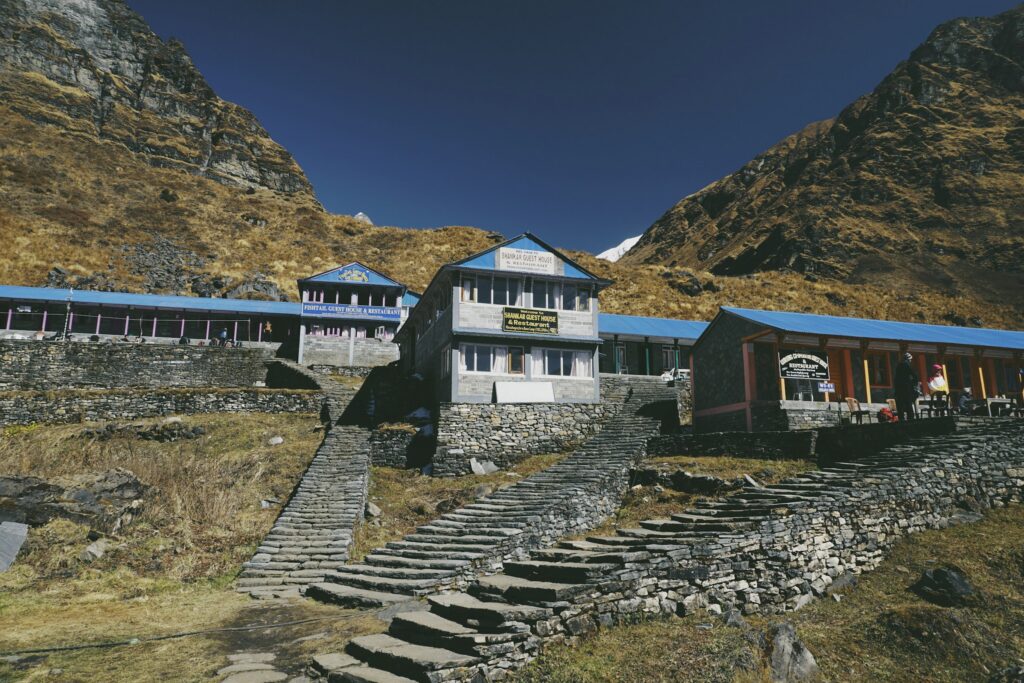
Every night of the trek is spent in teahouses: simple mountain lodges with twin rooms and a shared dining room with a stove, which is where everyone gathers as evening falls. The higher you go, the more basic they get: up high, wifi, hot showers and charging your phone cost extra.
The food is simple and plentiful. The staple is dal bhat, rice with lentils, vegetable curry and pickles, and refills are free as many times as you like. Teahouses also serve pasta, soups, momos and the classic milk tea.
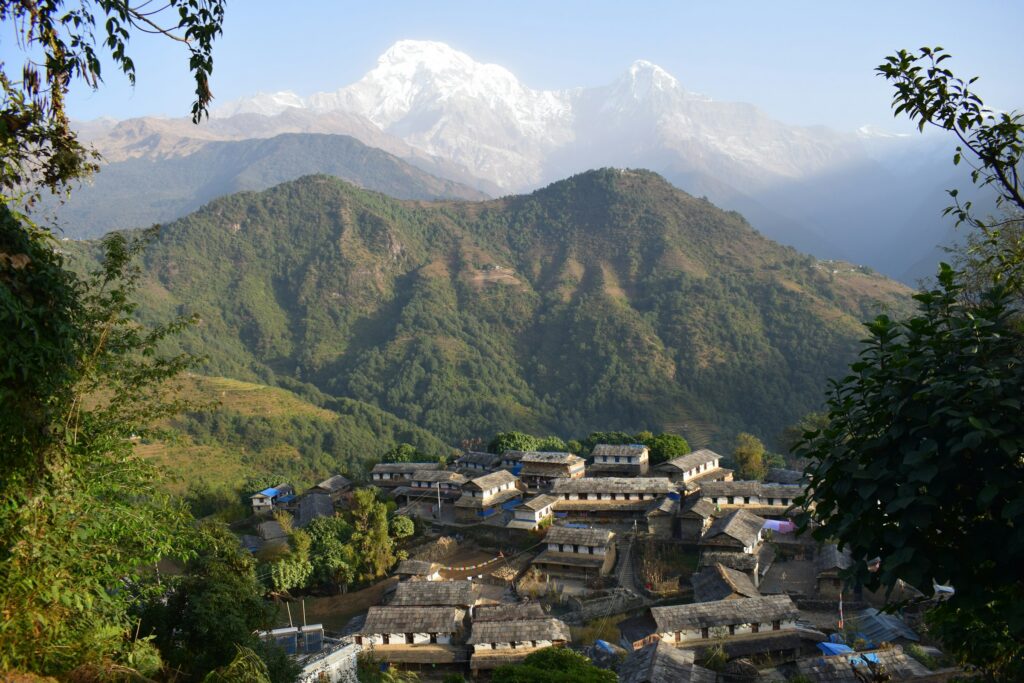
The trail crosses Gurung and Magar country, farming communities with deep roots in these hills. Ghandruk and Chhomrong, with their stone houses stepped down the slopes, are two of the prettiest villages on the route.
They are Nepal’s two signature treks and they are less alike than people think. Annapurna is shorter, lower (4,130 m against 5,364 m) and passes through forests and Gurung villages. Everest is longer, higher and colder, always in sight of peaks from 6,000 to 8,000 metres. We compare them point by point in Annapurna Base Camp vs Everest Base Camp: which one?
If you have days to spare, the easiest thing is to stay on in Pokhara: the lake, paragliding, yoga or simply resting after the trek. Our 4-day Pokhara trip fits nicely at the end. And if the Himalaya has got under your skin and you want another quiet valley, the Langtang Valley trek also runs over Easter.
How many days do you need for Annapurna Base Camp?
Seven days on the trail from Pokhara, there and back. Our trip is 12 days in total from Kathmandu.
Is the Annapurna Base Camp trek difficult?
It is moderate, with no technical sections. It calls for good fitness because of the 4 to 6-hour days and the thousands of stone steps.
When is the best time to trek to Annapurna Base Camp?
Spring (March to May) and autumn (October and November). Rhododendrons bloom in spring; skies are usually clearer in autumn.
How high is Annapurna Base Camp?
4,130 metres, in the Annapurna Sanctuary, surrounded by peaks over 7,000 metres with Annapurna I (8,091 m) in front of you.