In northern Pakistan, where three of Asia’s great mountain ranges meet — the Himalaya, the Hindu Kush and the Karakoram — rises one of the greatest concentrations of high mountains on the planet. At the heart of the Karakoram runs the Baltoro Glacier: a river of ice and rock more than 60 kilometres long that creeps slowly between granite spires to Concordia, the meeting point of some of the highest mountains on Earth. At the very end of it all stands K2.
At 8,611 metres, K2 is the second-highest mountain in the world and, for many climbers, the hardest. It owes its name to a British surveyor, Thomas Montgomerie, who in 1856 numbered the Karakoram peaks as he recorded them; no local name ever caught on, so the code stuck. An Italian expedition made the first ascent in 1954, and it was not until 2021 that a Nepali team achieved the first winter ascent.
The trek to K2 Base Camp is one of the great mountain walks of the world. Once you leave Askole behind there are no villages or lodges: you sleep in tents, with a team of cooks and Balti porters carrying everything, and much of the walking is on the glacier itself. It is longer, more remote and harder than Everest Base Camp, and far less crowded.
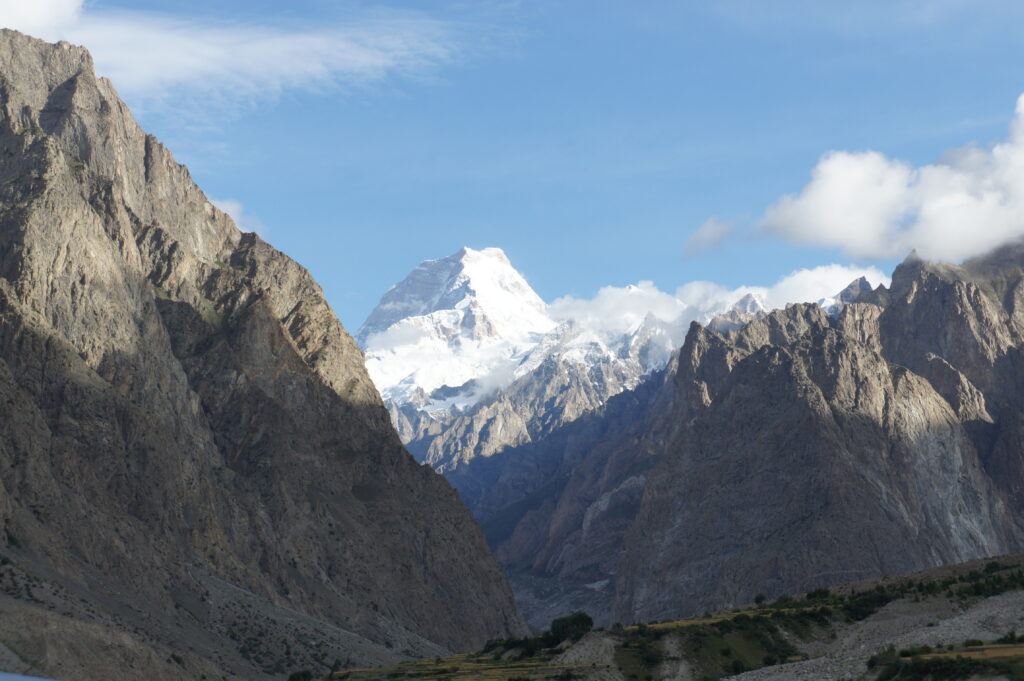
It all starts in Skardu, the capital of Baltistan, reached by plane from Islamabad. From there, about six hours of jeep track up the Shigar Valley lead to Askole, at around 3,000 metres, the last inhabited village before the glacier.
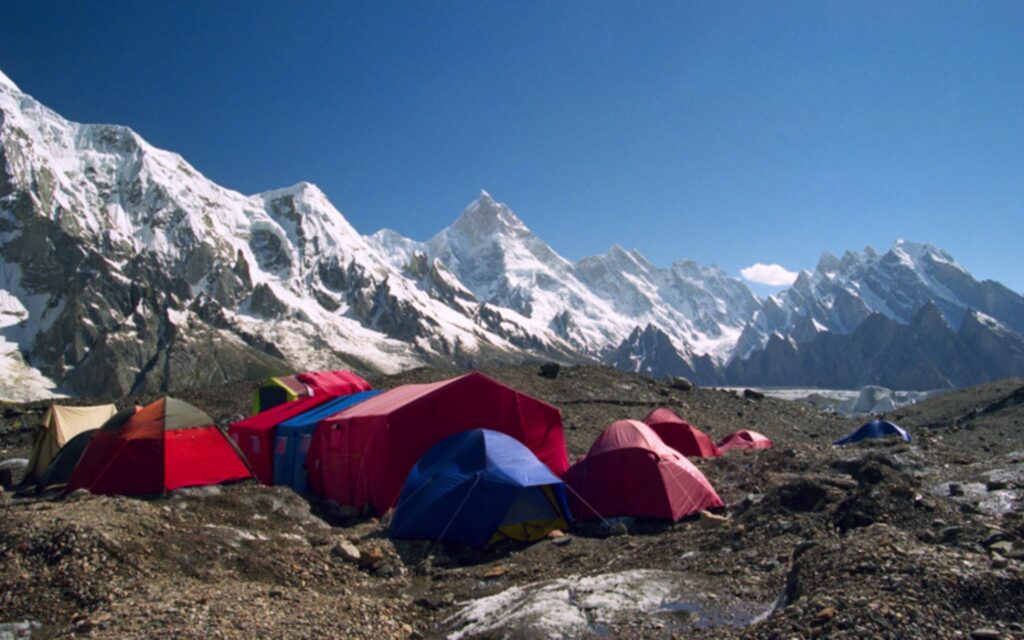
The first days follow the Braldu River valley, hot and dusty, through the camps of Jhola and Paiju. At Paiju most groups stop for a day to acclimatise. Then you finally set foot on the Baltoro and the landscape changes completely: on one side the Trango Towers, with some of the highest granite walls in the world; then Masherbrum, the Cathedral and, on the horizon, the huge bulk of Broad Peak. The camps of Urdukas and Goro II follow one another along the moraine until you reach Concordia, at about 4,690 metres.
Concordia is the confluence of the Baltoro and Godwin-Austen glaciers, and takes its name from another glacier junction in the Bernese Alps. It is one of the most impressive mountain amphitheatres anywhere, the place the photographer Galen Rowell called “the throne room of the mountain gods”: from here you see K2, Broad Peak, Gasherbrum IV, whose west face glows in the last light of the evening, and a ring of peaks over seven thousand metres.
From Concordia, a day out and back leads to the base camps of Broad Peak and K2, at about 5,150 metres. Near K2 Base Camp stands the Gilkey Memorial, which remembers the climbers who have died on the mountain.
Rather than return the same way, many itineraries cross the Gondogoro La, a 5,585-metre pass linking the Baltoro to the Hushe Valley. It is the hardest and most spectacular day of the trip. You leave Ali Camp in the early hours, by headtorch, to cross while the snow is firm; the final climb and the very steep descent are done in crampons and, depending on conditions, with a harness on fixed ropes. In season, a rescue team from the Hushe Valley, with posts at Ali Camp and Khuispang, fixes those ropes at the start of summer, maintains them and takes them down at the end of August. From the top you see K2, Broad Peak and the Gasherbrums.
The pass always depends on snow and weather. If it is not in condition, the usual alternative is to return down the Baltoro. On the other side lies the green, flower-filled Hushe Valley, beneath the sharp pyramid of Laila Peak.
The season runs from mid-June to mid-September, with July and August the most settled months. Days in the valley are hot and dry, and at night in Concordia the temperature drops well below freezing. It can snow at any point in the summer. Early in the season there is usually more snow on the Gondogoro La, and at the end of August its fixed ropes come down, so the crossing is planned between late June and August.
Our departure is 19 June to 7 July 2027: nineteen days from Islamabad, with the flight to Skardu, permits, local guide, cook and porters included.
See the K2 Base Camp and Baltoro Trek
The Baltoro lies within Central Karakoram National Park and is a restricted area: you cannot trek it independently. The trekking permit is arranged by a registered Pakistani agency, and the trip is done with a local guide. You also need a visa for Pakistan, applied for online with a letter of invitation from the agency.
The flight from Islamabad to Skardu is short and spectacular, with Nanga Parbat out of the window, but it depends on the weather and is often cancelled. That is why good itineraries include spare days and, if the plane does not fly, the alternative is the road, a day or more. Once on the glacier there is no reliable signal and helicopter rescues can only happen if they have been arranged in advance, so you need travel insurance that covers trekking above 5,500 metres and evacuation.
The trek to base camp is not technical, but it is very demanding. You walk for about ten days in a row, 6 to 8 hours a day, almost always on moraine and loose rock, above 4,000 metres for a week, with the Gondogoro La as the final test, a 10 to 12-hour day. You need very good fitness, previous experience of multi-day treks at high altitude and, for the pass, to be comfortable in crampons.
Acclimatisation is gradual, as it takes a week to reach Concordia. Even so, it is worth training for months beforehand. We can help you prepare with a training plan designed for this kind of trip.
How long is the K2 Base Camp trek?
About 12 to 14 days of walking, and 18 to 22 days in total from Islamabad including flights, transfers and spare days. Our programme is 19 days, crossing the Gondogoro La.
How high is K2 Base Camp?
About 5,150 metres. Concordia, the last camp before the visit, is at about 4,690 metres, and the Gondogoro La at 5,585.
Can you do the K2 trek independently?
No. The Baltoro is a restricted area and the permit can only be arranged by a registered Pakistani agency, with a local guide.
Is it harder than Everest Base Camp?
Yes. It is longer, you walk on glacier and loose rock, there are no villages or lodges and you always sleep in a tent. If you cross the Gondogoro La, there is also a section in crampons on fixed ropes.
When is the best time to go?
From mid-June to mid-September, with July and August the most settled months.